
Table of Contents
- Why Crispness Matters: Understanding Baklava's Texture
- Room Temperature vs. Refrigeration: Where to Store Baklava
- How Long Does Baklava Last at Different Storage Temperatures
- Best Containers and Wrapping Materials for Maximum Crunch
- Can You Freeze Baklava Without Losing Texture
- How to Reheat Baklava to Restore Crunch and Freshness
- Common Storage Mistakes That Ruin Baklava
- Frequently Asked Questions
Last Updated: September 27, 2026
Why Crispness Matters: Understanding Baklava's Texture
The crunch in baklava is everything. It's what separates a memorable dessert from a disappointing one. That satisfying snap when you bite through the phyllo dough is the result of careful layering, proper baking, and, critically, how to store baklava for maximum crunch afterward.
Even the best-baked baklava loses its crispness without proper storage. Moisture is the enemy, it seeps into the phyllo, softens the layers, and turns that golden crunch into a chewy texture.
Phyllo dough is incredibly thin and designed to be crispy. When humidity or condensation reaches it, the dough absorbs moisture and becomes limp. The syrup can also accelerate this breakdown if the pastry isn't protected properly.
Room Temperature vs. Refrigeration: Where to Store Baklava
Room temperature is best for short-term storage. Keep baklava in a cool, dry place away from direct sunlight, a kitchen pantry or cupboard works perfectly.
Refrigeration is generally a mistake. Temperature swings when you open and close the door create condensation that softens the pastry. If you must refrigerate, use an airtight container and minimize opening it.
The ideal storage temperature is between 60-70°F. Below that, condensation forms; above that, heat degrades the ghee or butter and causes syrup to crystallize.
Key storage temperature guidelines:
- Room temperature (60-70°F): Best for 1-2 weeks
- Pantry or cupboard: Ideal for maintaining crispness
- Refrigerator: Only if absolutely necessary; use airtight containers
- Avoid: Warm kitchens, sunny windowsills, areas near heat sources
Direct sunlight heats the container, accelerates fat oxidation, and causes the honey glaze to become sticky or crystallized.
How Long Does Baklava Last at Different Storage Temperatures
Properly stored baklava at room temperature lasts 1-2 weeks. Once opened, consume within 3-5 days for optimal crispness.
Refrigerated baklava lasts up to 3 weeks, though texture gradually softens as moisture is absorbed.
Properly wrapped and frozen, baklava lasts 2-3 months, the best option for long-term preservation.
Signs of spoilage: visible mold, off smell, mushy texture, darkened phyllo, or fermented filling.
Storage duration at a glance:
- Room temperature: 1-2 weeks
- Refrigerated: 2-3 weeks
- Frozen: 2-3 months
- After opening: 3-5 days at room temperature
Best Containers and Wrapping Materials for Maximum Crunch
The container you choose directly impacts crispness. Not all airtight containers perform equally, material determines moisture resistance.
Glass airtight containers are the gold standard for room temperature storage. Glass is non-porous, maintains stable humidity, and won't leach chemicals. Look for silicone or rubber gasket seals for a tighter barrier than plastic snap-lids.
Metal (aluminum or stainless steel) containers are excellent for freezing and block moisture and light. Metal conducts temperature quickly, so let containers acclimate to room temperature before opening to prevent condensation.
Plastic containers are convenient but slightly porous and absorb moisture and odors over time. Plastic works for short-term storage (under 1 week); for longer preservation, use glass or metal. Choose thick-walled containers with tight-fitting lids.
Wrapping individual pieces adds protection. Plastic wrap creates a moisture barrier for room temperature storage. Aluminum foil blocks light and air for freezing. A two-layer approach, plastic wrap then foil, is ideal for 2-3 month freezer storage.
Silica gel packets are underrated tools for long-term room temperature storage. Food-grade silica gel absorbs excess moisture without affecting taste. Place one small packet (about 1-2 grams) inside your airtight container. It will absorb moisture that naturally evaporates from the baklava and any residual humidity in the container. Replace or reactivate the packet every 3-5 days by heating it in a 250°F oven for 10 minutes until it's dry again. This technique extends room temperature shelf life from 2 weeks to nearly 4 weeks.
Avoid these materials:
- Paper bags and cardboard boxes: Too porous; allow moisture and air exchange
- Cloth or linen wraps: Breathable, which defeats the purpose of moisture protection
- Wax paper alone: Not a complete barrier; use it only as a layer between pieces, not as the primary seal
- Unsealed containers: Even "mostly airtight" containers allow slow moisture infiltration
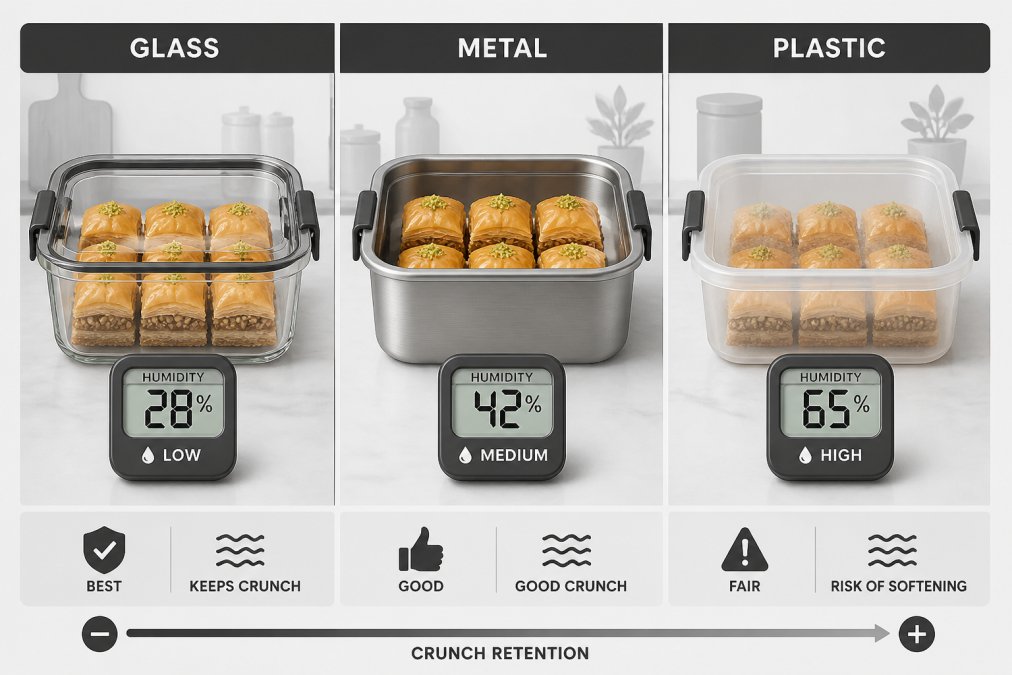
Container material performance summary:
- Glass with silicone gasket: Best for room temperature; maintains stable humidity; no moisture absorption
- Metal (aluminum/stainless): Best for freezing; superior light barrier; risk of exterior condensation during temperature transitions
- Plastic (food-grade): Adequate for short-term (under 1 week); absorbs odors; slightly porous over extended storage
- Plastic wrap: Good moisture barrier for individual pieces; best paired with foil for freezing
- Aluminum foil: Ideal for freezer storage; complete light and air block; use as outer layer after plastic wrap
- Silica gel: Extends room temperature storage by absorbing ambient moisture; reusable and cost-effective
Can You Freeze Baklava Without Losing Texture
Yes, you can freeze baklava effectively. Freezing stops the clock on freshness and can preserve crispness better than room temperature storage over long periods. The key is proper wrapping.
Wrap each baklava piece individually in plastic wrap, then place the wrapped pieces in a freezer-safe airtight container or freezer bag. Remove as much air as possible before sealing. Alternatively, wrap the entire batch in plastic wrap, then in aluminum foil.
Label your container with the date. Baklava keeps well in the freezer for 2-3 months. Beyond that, freezer burn becomes more likely, and the phyllo may develop an off flavor.
When you're ready to eat frozen baklava, thaw it at room temperature in its sealed container. Don't open the container while it's thawing, condensation will form and soften the pastry. Allow 1-2 hours for thawing, depending on the size of the pieces.
Freezing works particularly well for unbaked baklava if you have access to it. Unbaked baklava can be frozen for up to 6 months and baked directly from frozen with minimal texture loss.
How to Reheat Baklava to Restore Crunch and Freshness
If your baklava has softened, understanding why it happened is the first step to fixing it. Baklava loses crunch primarily through two mechanisms: moisture absorption from humidity and syrup migration into the phyllo layers. Reheating can partially reverse moisture loss, but it cannot undo syrup absorption, that's permanent. However, gentle reheating can restore surface crispness and improve the eating experience.
The science of syrup absorption: Baklava's honey or sugar syrup is hygroscopic, meaning it actively pulls moisture from the air and gradually seeps into the phyllo layers over time (Honey: a reservoir for microorganisms and an inhibitory agent for microbes). This is why baklava stored in humid environments or opened containers deteriorates faster. Once syrup has migrated deep into the phyllo, reheating won't remove it. But if baklava has only lost surface crispness due to ambient humidity (not syrup saturation), gentle heat can evaporate that surface moisture and restore the snap.
Oven method (best for most situations): Preheat your oven to 275-300°F. This low temperature is critical, higher heat will re-bake the baklava and risk burning the honey glaze or drying out the interior. Place baklava pieces on a baking sheet lined with parchment paper (don't stack them). Warm for 5-8 minutes, checking at the 5-minute mark. The goal is to feel warmth when you touch a piece, not to heat it through completely. Remove immediately when warm.
The low temperature allows surface moisture to evaporate without driving moisture deeper into the pastry or caramelizing the syrup. As the baklava cools for 2-3 minutes after removal, the phyllo will crisp up noticeably. This works best for baklava that has been stored for 1-2 weeks and has lost surface crispness but hasn't become completely soggy.
Toaster oven method (for small quantities): Toaster ovens are more efficient for 2-4 pieces. Set to 300°F and place baklava directly on the rack (or on a small piece of foil). Warm for 3-5 minutes. The smaller chamber means faster, more even heating. This method is ideal if you're eating just one or two pieces and don't want to heat your full oven.
Air fryer method (emerging technique for maximum crispness): If you have an air fryer, set it to 300°F and place baklava in the basket without stacking. Heat for 3-4 minutes. The circulating hot air evaporates surface moisture very efficiently and can restore crispness better than a conventional oven for pieces that are only moderately softened. This method works particularly well for baklava that has been refrigerated, as the cold has made the phyllo slightly limp but the syrup hasn't fully migrated.
Avoid the microwave: Microwave heating is the enemy of crispness.
Reheating temperature and time guide:
- Conventional oven: 275-300°F for 5-8 minutes
- Toaster oven: 300°F for 3-5 minutes
- Air fryer: 300°F for 3-4 minutes
- Microwave: Not recommended
- Cool-down time before eating: 2-3 minutes for maximum crispness
Common Storage Mistakes That Ruin Baklava
The biggest mistake is storing baklava in the refrigerator without thinking about condensation. People assume cold equals fresh, but the temperature swings in a fridge create moisture that destroys crispness.
Common mistakes to avoid:
- Refrigerating without airtight containers
- Leaving baklava in permeable packaging
- Storing near heat or direct sunlight
- Mixing different baklava types
- Freezing without proper wrapping
- Opening containers repeatedly during storage
Frequently Asked Questions
Is baklava supposed to be kept in the fridge or at room temperature?
Room temperature is best for maintaining baklava's crispness. Store it in an airtight container away from direct sunlight and humidity for up to 3 days. Refrigeration can introduce condensation that softens the phyllo layers. Only refrigerate if your kitchen is extremely warm or humid, and keep the container sealed to minimize moisture exposure.
How long can baklava stay unrefrigerated before it goes stale?
Baklava stays fresh at room temperature for 2-3 days in an airtight container. After that, the phyllo begins to absorb moisture from the air and loses its crunch. Factors like humidity and room temperature affect shelf life; cooler, drier environments extend freshness.
Can you freeze baklava without ruining the texture?
Yes, you can freeze baklava for up to 3 months. Wrap individual pieces tightly in plastic wrap, then place them in an airtight freezer container to prevent freezer burn. Thaw at room temperature for 1-2 hours before eating. Properly frozen baklava retains its crispy texture because the cold slows moisture migration. Avoid thawing in the refrigerator, as condensation will soften the phyllo.
How can I revive stale baklava and restore its crunch?
Reheat stale baklava in a 150°C (300°F) oven for 5-10 minutes to restore crispness. The gentle heat drives out moisture and revitalizes the phyllo layers. For faster results, use a toaster oven. Avoid microwaving, which traps steam and makes the pastry soggy. This method works best within the first week of storage; older baklava may not fully recover its original texture.